
LATEST NEWS


How Braille Handrails Support Safe and Inclusive Aging Communities
As populations continue to age across the world, cities, transportation hubs, healthcare facilities, and residential buildings are facing new challenges in accessibility and safety. Creating environments that allow elderly individuals to move independently and confidently has become a priority for architects, facility managers, and urban planners.
Among the many accessibility solutions available today, braille handrails play a critical role in supporting safe navigation, improving wayfinding, and promoting inclusive design. When combined with tactile paving, warning indicators, and accessible signage systems, braille handrails help create environments that are safer not only for people with visual impairments but also for aging populations.
According to global demographic trends, the number of people aged 65 and above continues to grow rapidly. As people age, they often experience:
Reduced vision and contrast sensitivity
Decreased mobility and balance
Slower reaction times
Greater risk of falls and accidents
Difficulty navigating unfamiliar public spaces
For many seniors, even simple tasks such as finding a stairwell, locating an elevator, or identifying a floor level can become challenging.
Modern accessibility design aims to reduce these barriers by providing clear physical and tactile guidance throughout buildings and public infrastructure.
A braille handrail is a handrail system that incorporates raised tactile text and braille information directly onto the handrail surface or attached signage.
These handrails provide important information such as:
Floor numbers
Room identification
Exit directions
Emergency routes
Elevator locations
Public facility information
Users can identify important location and directional information through raised text and braille, enabling independent navigation without depending entirely on visual signage. For this reason, braille handrails are widely used in healthcare facilities, senior living communities, transportation hubs, educational institutions, government buildings, commercial properties, and residential developments, where accessibility, safety, and compliance with universal design principles are increasingly important.
One of the biggest concerns for elderly individuals is losing independence.
Braille handrails help users identify their location while moving through stairways, corridors, and public spaces. This reduces confusion and allows seniors to navigate with greater confidence.
For individuals with age-related vision loss, tactile information becomes an essential navigation tool.
Falls remain one of the leading causes of injury among older adults.
Braille handrails provide both physical support and directional information at staircases. When users can confirm floor numbers and directions through touch, they are less likely to become disoriented.
Combining braille handrails with anti-slip stair nosing and tactile warning indicators further improves safety throughout the building.
Universal design focuses on creating spaces that are usable by people of all ages and abilities.
Rather than developing separate facilities for specific groups, universal design integrates accessibility into everyday environments.
Braille handrails are a perfect example of this approach because they benefit:
Blind users
Visually impaired individuals
Elderly people with declining eyesight
Temporary injury patients
First-time visitors navigating unfamiliar buildings
The result is a more inclusive environment for everyone.
Braille handrails work most effectively when integrated into a complete accessibility system.
A typical accessible navigation system may include:
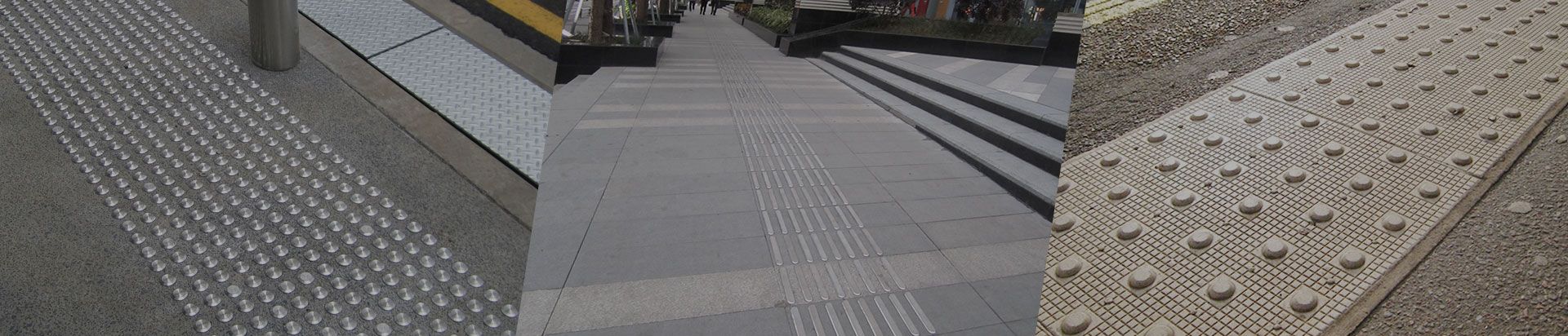
Tactile indicators provide directional and warning information through textured ground surfaces.
The directional tactile indicator guide pedestrians along safe routes, while warning indicators alert users to hazards such as:
Stairways
Platform edges
Crosswalks
Escalators
Together with braille handrails, tactile indicators create a continuous navigation path for users.
Braille signs provide additional information throughout buildings, including room identification, restroom locations, exits, and safety instructions.
Strategically placing braille signage near entrances, elevators, and staircases improves wayfinding and accessibility compliance.
Anti-slip stair nosing increases stair visibility and reduces slip hazards, making it particularly valuable in facilities serving elderly users.
As governments invest in age-friendly urban development, braille handrails are increasingly being specified in public projects.
Common applications include:
Hospitals, rehabilitation centers, and nursing homes require clear navigation systems to help patients and visitors move safely throughout large facilities.
Airports, railway stations, subway systems, and bus terminals often experience heavy pedestrian traffic.
Braille handrails and tactile indicators help passengers identify routes, exits, and platform areas independently.
Retirement communities and assisted living facilities increasingly incorporate braille handrails as part of comprehensive accessibility planning.
Schools and universities are adopting inclusive infrastructure to accommodate students, staff, and visitors with diverse accessibility needs.
The effectiveness of an accessibility system depends heavily on product quality, durability, and compliance with international standards.
When selecting a tactile indicator manufacturer, buyers should evaluate:
Material quality (304/316 stainless steel, aluminum, brass, PU)
Slip resistance performance
Corrosion resistance
Load-bearing capacity
Custom manufacturing capability
Compliance with accessibility standards
Production capacity for large-scale projects
A professional manufacturer can provide coordinated solutions that combine tactile indicators, braille signs, stair nosing, and braille handrails into a complete accessibility package.
Large commercial and public infrastructure projects often require customized and high-volume signage solutions.
Working with a supplier that offers wholesale braille signs provides several advantages:
Consistent quality across projects
Customized text and braille content
Multiple material options
Faster project delivery
Better cost efficiency for bulk orders
Custom braille signs can be designed to match architectural aesthetics while maintaining accessibility compliance.
As a professional tactile indicator manufacturer, Wuyi Xiongchang Hardware Manufacturing Co., Ltd. has specialized in accessibility products since 2001.
The company manufactures a comprehensive range of products, including:
Braille handrails
Braille signage systems
Tactile indicator studs
Directional tactile strips
Tactile paving solutions
Stair nosing systems
Stainless steel accessibility products
With extensive manufacturing experience, advanced CNC equipment, and international project support capabilities, Xiongchang helps contractors, architects, and distributors implement reliable accessibility solutions for public and private developments worldwide.
As cities adapt to aging populations, accessibility is no longer optional—it is an essential component of modern infrastructure.
Braille handrails contribute significantly to safer, more inclusive communities by supporting independent navigation, reducing safety risks, and improving the overall user experience for elderly and visually impaired individuals.
When integrated with tactile indicators, braille signage, and other accessibility products, braille handrails become part of a comprehensive wayfinding system that helps create environments where everyone can move with confidence, dignity, and independence.
LATEST NEWS
 English
  日本語
日本語  français
  Deutsch
  Español
  italiano
  русский
  português
  العربية
  ไทย
ไทย  Polska
  中文
中文